
Age-dependent alternative splicing (ADAS) and cellular juvenescence
Our lab investigates the molecular basis of pediatric intractable diseases and develops new therapies.
Toward that goal, we focus on the fact that children possess a number of strengths that adults have lost. Children's bodies are small and fragile, yet they have great regenerative capacity, high learning ability, and the capacity to grow their bodies. We refer to this suite of features as juvenile properties (also called pediatric properties).

These juvenile properties may be harnessed for disease therapy, but the mechanisms that implement them are largely unknown. Using animal models, we investigated genes strongly expressed during childhood growth and reported them as Juvenility-Associated Genes (JAGs) (ref. 1). We found that one of their roles is to maintain the youthfulness of cells — which we named cellular juvenescence (ref. 2). However, how JAGs maintain cellular juvenescence had remained unclear.
In our most recent paper, we showed that alternative splicing mediates this process. Splicing is a mechanism that expands the functional repertoire of a gene. Genetic information is written in the nuclear DNA using four letters (A, C, G, T); this is transcribed into RNA, which in turn serves as a template for protein synthesis. Splicing removes unneeded regions (introns) from the RNA and joins the needed regions (exons). Importantly, how the unneeded parts are selected can vary — this is alternative splicing, through which a single gene produces multiple RNA and protein variants.
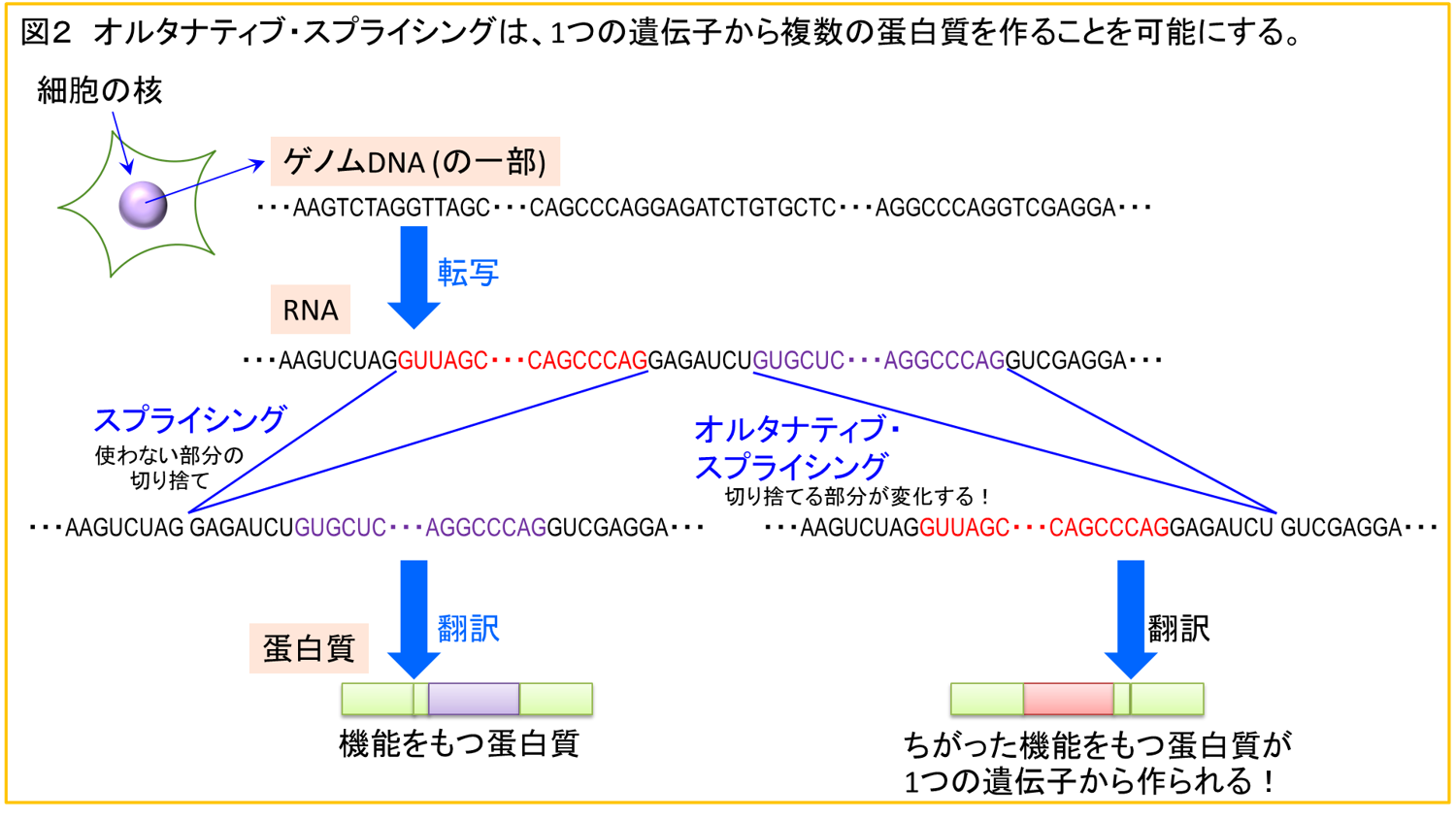
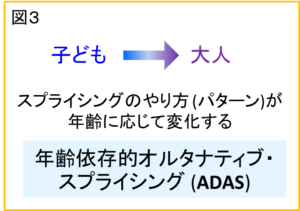
Our hypothesis was that between children and adults, the same gene generates different RNAs via alternative splicing. Using mice, we showed that alternative splicing patterns are indeed widely different between juvenile and adult animals. We named this child-specific splicing Age-Dependent Alternative Splicing (ADAS) (ref. 3).
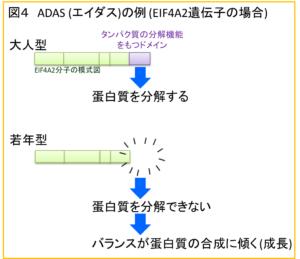
How does ADAS realize juvenile properties? We found that genes with juvenile-vs-adult splicing differences are enriched for anabolic metabolism — the process of building the body (bones, muscle, organs) from nutrients. For example, the molecule EIF4A2 inhibits protein synthesis (translation) in adults. The ADAS-processed form expressed in children is shorter, lacking the inhibitory domain. As a result, juvenile EIF4A2 cannot inhibit translation. This likely contributes to the robust protein synthesis required for childhood growth.
For pediatric intractable diseases, our findings suggest that promoting child-type alternative splicing could enhance bodily growth and regeneration. Our future work aims to resolve the detailed molecular mechanisms and to directly test the therapeutic potential.
References
- Jam FA, Kadota Y, Mendsaikhan A, Mori M. "Identification of juvenility-associated genes in the mouse hepatocytes and cardiomyocytes." Scientific Reports, 8, 3132 (2018). doi:10.1038/s41598-018-21445-3
- Tano A, Kadota Y, Morimune T, et al. "Juvenility-associated lncRNA Gm14230 maintains cellular juvenescence." Journal of Cell Science, (2019). doi:10.1242/jcs.227801
- Kadota Y, Jam FA, Yukiue H, et al. "Srsf7 establishes the juvenile transcriptome through age-dependent alternative splicing in mice." iScience, 23(3):100929 (2020). doi:10.1016/j.isci.2020.100929
TBC1D24 forms intracellular macrostructures
Within cells, many organelles have been named — mitochondria, ribosomes, and so on. But many additional structures without names, and of unclear function, are also observed. While studying TBC1D24, a juvenility-associated gene linked to epileptic encephalopathy, we discovered that it forms distinctive ring-shaped structures in cells. Though too small to see without a microscope, these are quite large on the cellular scale and can be regarded as intracellular macrostructures.

The ring structure is thought to be formed by many TBC1D24 molecules linking together. TBC1D24 has GTP-hydrolyzing activity and is thought to act on cell migration, deformation, and vesicle transport via cytoskeletal rearrangement. The ring structure is likely to be closely related to these enzymatic activities, but the mechanism remains to be established. Importantly, mutations in TBC1D24 cause the pediatric intractable disease epileptic encephalopathy. Elucidating the function of these TBC1D24 macrostructures is therefore critical both for understanding the disease and for developing therapies.
Bex1 is a juvenile IDP that mediates microtubule polymerization
Bex1 is an intrinsically disordered protein (IDP) expressed in the juvenile period. It forms fibrous macrostructures, and by providing a reaction field that concentrates GTP, it promotes the polymerization of tubulin. This activity is essential for the formation of primary cilia.

Bex1-knockout mice present ciliopathy phenotypes resembling Joubert syndrome, demonstrating the physiological importance of Bex1. These findings suggest a new molecular mechanism in which the properties of intrinsically disordered regions enable a phase-separation-like process that creates localized chemical reaction fields inside cells.

